
New to Task Matrix 3x3?
Start here
Task Matrix 3x3 helps you decide what deserves attention by separating Importance from Urgency. Instead of keeping one long list, you place each task in one of nine cells and work in the numbered order that fits your preference.
Your first five minutes
- Add one real task. Select Add task, enter a short action such as “Call supplier about deck stain,” and add details in Notes if needed.
- Choose its place. Decide how much the task matters—High, Normal, or Low—and how soon it needs attention—Now, Soon, or Later.
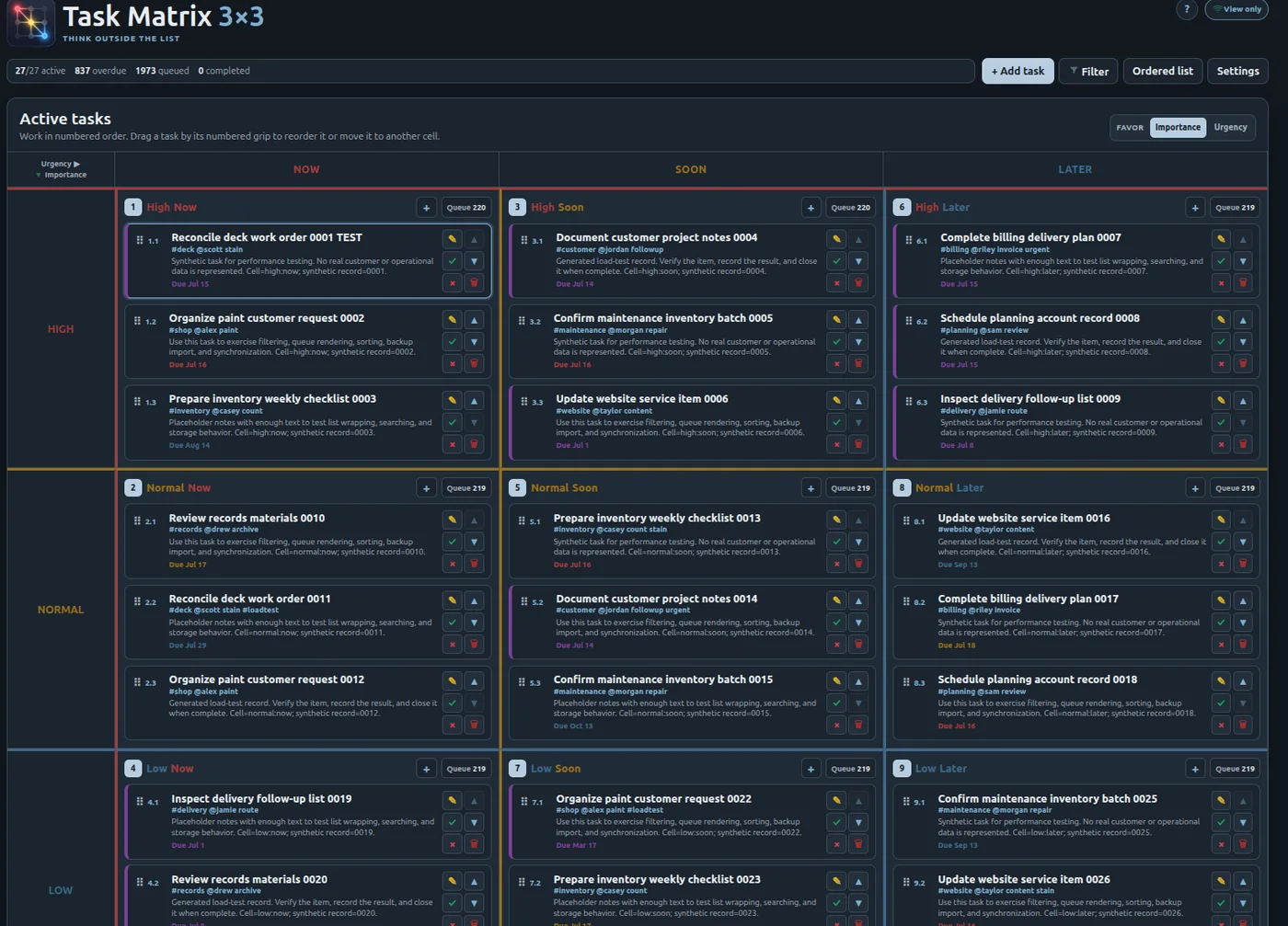
- Read its number. A number such as 3.1 means priority cell 3, active slot 1. Lower cell numbers come first. Within a cell, slot 1 comes before slot 2, then slot 3.
- Add a few more tasks. Do not worry about making every choice perfect. You can edit, move, or reorder a task at any time.
- Work from the lowest number upward. Complete a task with the checkmark. It moves to History, where you can restore it if needed.
Three things to know before you begin
- Each cell shows no more than three active tasks. Extra tasks wait in that cell’s queue.
- Queues do not promote themselves. You choose what comes forward next.
- An account is optional. Use one only when you want shared snapshots, email reminders, recovery, or more than one connected device.
Task-oriented shortcuts
How do I…?
Choose the result you want. Each link goes directly to the relevant instructions.
How priority works
The matrix
Every task belongs to one Importance level and one Urgency level. Their intersection determines the task’s cell.
| Level | Use it when… | Example |
|---|---|---|
| High importance | Failure would seriously affect a major goal, obligation, person, deadline, safety matter, or commitment. | Submit a required tax document. |
| Normal importance | The task is useful or necessary routine work, but the consequences are moderate. | Order regular shop supplies. |
| Low importance | The task is optional, minor, convenient, or has little consequence if delayed. | Try a different icon arrangement. |
| Now | It needs attention immediately or in your current work period. | Return a call before the office closes. |
| Soon | It belongs in the near-term plan, after current Now work. | Prepare notes for next week’s meeting. |
| Later | It is valid work with no immediate time pressure. | Research a future equipment upgrade. |
What the task numbers mean
An active task number has two parts. In 3.2, the first number is the cell’s overall priority and the second number is the task’s active position inside that cell. A queued number such as 3.Q2 means queue position 2 in priority cell 3.
The lowest active number is the next suggested task. Task Matrix 3x3 highlights it, but the final choice remains yours.
Favor Importance or Favor Urgency
The Favor setting changes how the nine cells are numbered and how priority sorting works. It does not change a task’s Importance or Urgency, and it does not move task records between cells.
Favor Importance
This is the default order. It gives the stronger advantage to Importance as the diagonal priority sequence moves through the matrix.
| Importance / Urgency | Now | Soon | Later |
|---|---|---|---|
| High | 1 | 3 | 6 |
| Normal | 2 | 5 | 8 |
| Low | 4 | 7 | 9 |
Favor Urgency
This order gives the stronger advantage to Urgency.
| Importance / Urgency | Now | Soon | Later |
|---|---|---|---|
| High | 1 | 2 | 4 |
| Normal | 3 | 5 | 7 |
| Low | 6 | 8 | 9 |
Custom priority pattern
Select Custom when neither standard diagonal gives the work order you want. High/Now remains priority 1 and Low/Later remains priority 9. In Settings, assign priorities 2–8 to the other seven cells in any order that makes sense to you.
The custom pattern is a real priority order, not decoration. It controls the numbers on the grid, the highlighted next task, queue numbers, and priority sorting in Ordered List. Grid orientation may transpose the screen, but it does not change your custom sequence.
Grid orientation is only presentation
Select the upper-left axis cell—or use Settings—to choose whether Importance or Urgency runs down the rows. Transposing the grid changes where cells appear on screen. It does not change priority numbers, task placement, or Ordered List order.
Daily task handling
Tasks and queues
Add a task
- Select Add task in the toolbar, or select the + in the cell where the task belongs.
- Enter the Task title. Keep it action-oriented and place background details in Notes.
- Add optional Tags and Notes.
- Choose Importance and Urgency. The Target cell line shows where the task will be placed.
- Optionally add a schedule using natural language or the touch builder, then choose up to three individual reminders.
- Select Save task.
Task fields
| Field | Purpose | Notes |
|---|---|---|
| Task | The action or result you want. | Required. Up to 180 characters. |
| Tags | People, projects, places, categories, or labels useful for filtering. | Use the ? beside Tags to see or insert your saved character conventions. |
| Notes | Context, instructions, reference information, or the next action. | Optional and searchable. |
| Importance | How much the task matters. | High, Normal, or Low. |
| Urgency | How soon the task needs attention. | Now, Soon, or Later. |
| Schedule | When the task should be finished and whether it recurs. | Type a supported phrase or use the touch builder. Review the interpreted dates before saving. |
| Reminders 1–3 | How far before a timed schedule individual output should be requested. | Choose None for all three to send no individual reminder. Date-only tasks may still appear in Daily Digest. |
| Recurrence outcome | Controls whether the series continues. | Complete and Skip create the next occurrence; Cancel ends the series. |
Useful tag conventions
Tags are plain text, so choose conventions that make sense to you. We use # for projects, @ for people, $ for status, = for labels, * for places. Examples include #deck for a deck project, @bob when we need Bob to do the work, $waiting when lumber isn't delivered yet, =critical for a task on the critical path, or *patio because it's a patio deck. These symbols have no special built-in meaning; they simply make tags easier to recognize and filter.
Open Settings → Tag definitions to add, change, or remove your character meanings. In the task editor, select the ? beside Tags to review the definitions. Select Insert to place a character into the Tags field, then type the value after it. Definitions are included in snapshots and JSON backups; changing a definition does not rewrite existing tags.
Edit a task
Select the task title or pencil button. Change any field and save. Changing Importance or Urgency moves the task to the matching cell. If the destination cell already has three active tasks, the moved task is inserted and the previous slot 3 task may move to the queue.
To stop a repeating series immediately, choose Cancel. To keep the current occurrence but remove recurrence, edit its schedule before completing it.
Task actions
| Control | Action | What happens |
|---|---|---|
| ✎ | Edit | Changes content, schedule, reminders, recurrence, or matrix location. |
| ▲ ▼ | Reorder | Moves an active task up or down inside its current cell. |
| ✓ | Complete | Records completed History and creates the next occurrence when recurrence is set. |
| ↷ | Skip | Dismisses this occurrence and its reminders, records skipped History, and creates the next recurring occurrence. |
| × | Cancel | Moves the task to History without creating a repeating occurrence. |
| 🗑 | Delete permanently | Removes the task after confirmation. |
| ⠿ 3.1 | Drag | Reorders an active task or moves it to another cell and position. |
Move or reorder an active task
On a larger screen
Press and hold the task’s numbered grip, drag it to the desired task position or cell, then release it. Dropping before or after another task chooses the insertion point.
On a compact or mobile screen
Open the cell, press and hold the numbered grip, and keep holding. A large 3x3 destination board appears. Move over slot 1, 2, or 3 in the destination cell, then release.
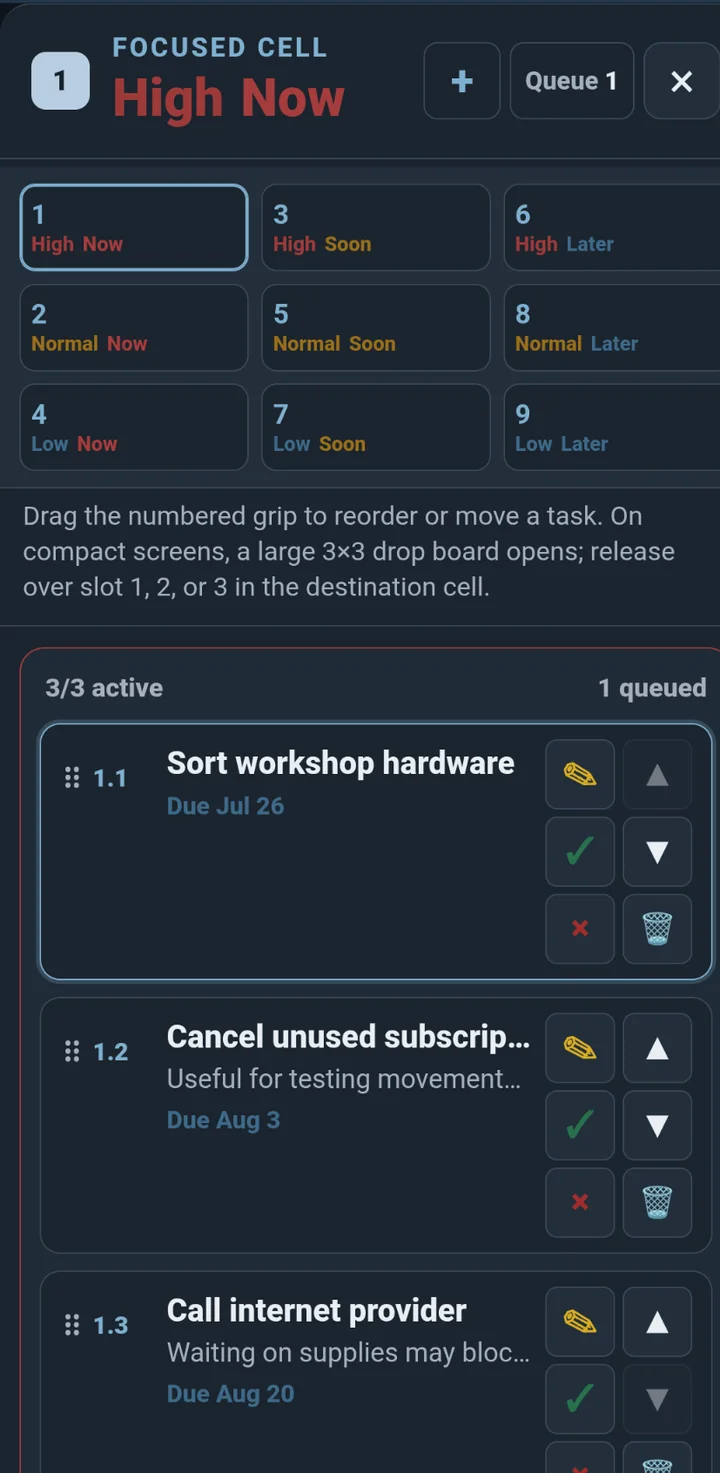
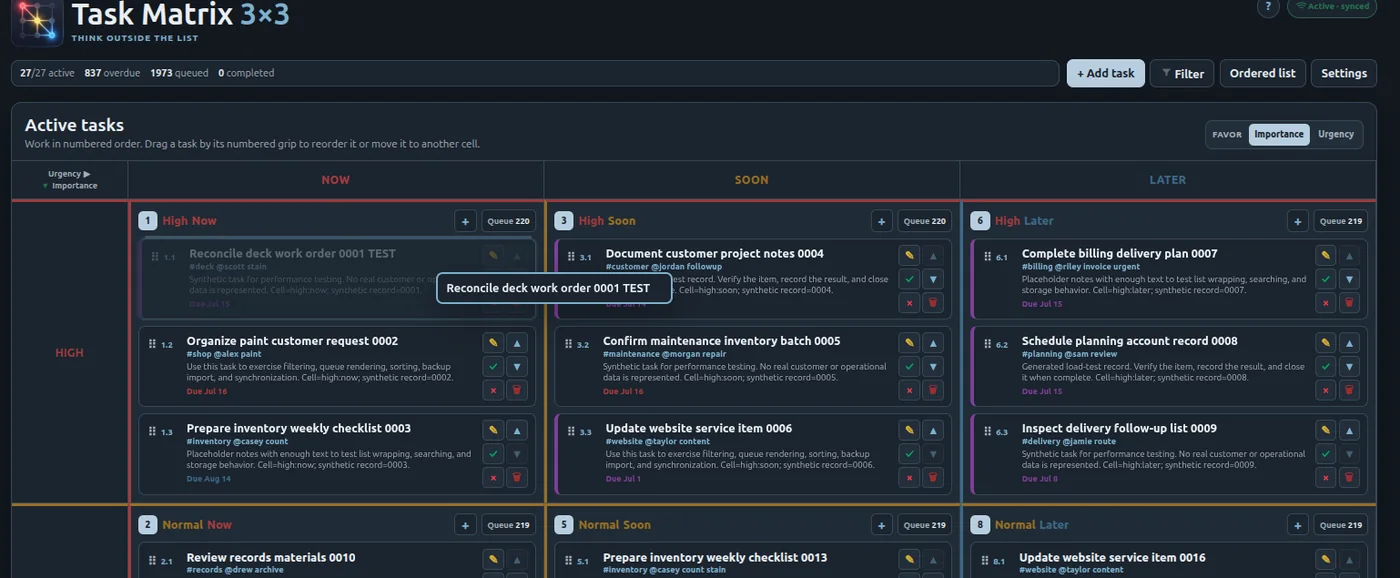
Moving into a full cell places the moved task at the selected slot and moves the old slot 3 task to queue position Q1. Moving within one cell changes only slot order.
Overflow work
Cell queues
Each matrix cell has three active slots and its own queue. A new task enters the queue when all three active slots are occupied.
Why promotion is manual
When you complete, cancel, delete, or move an active task, its slot stays open. Task Matrix 3x3 does not automatically decide which queued item should replace it. Open the queue and choose the task you want to promote.
Open and manage a queue
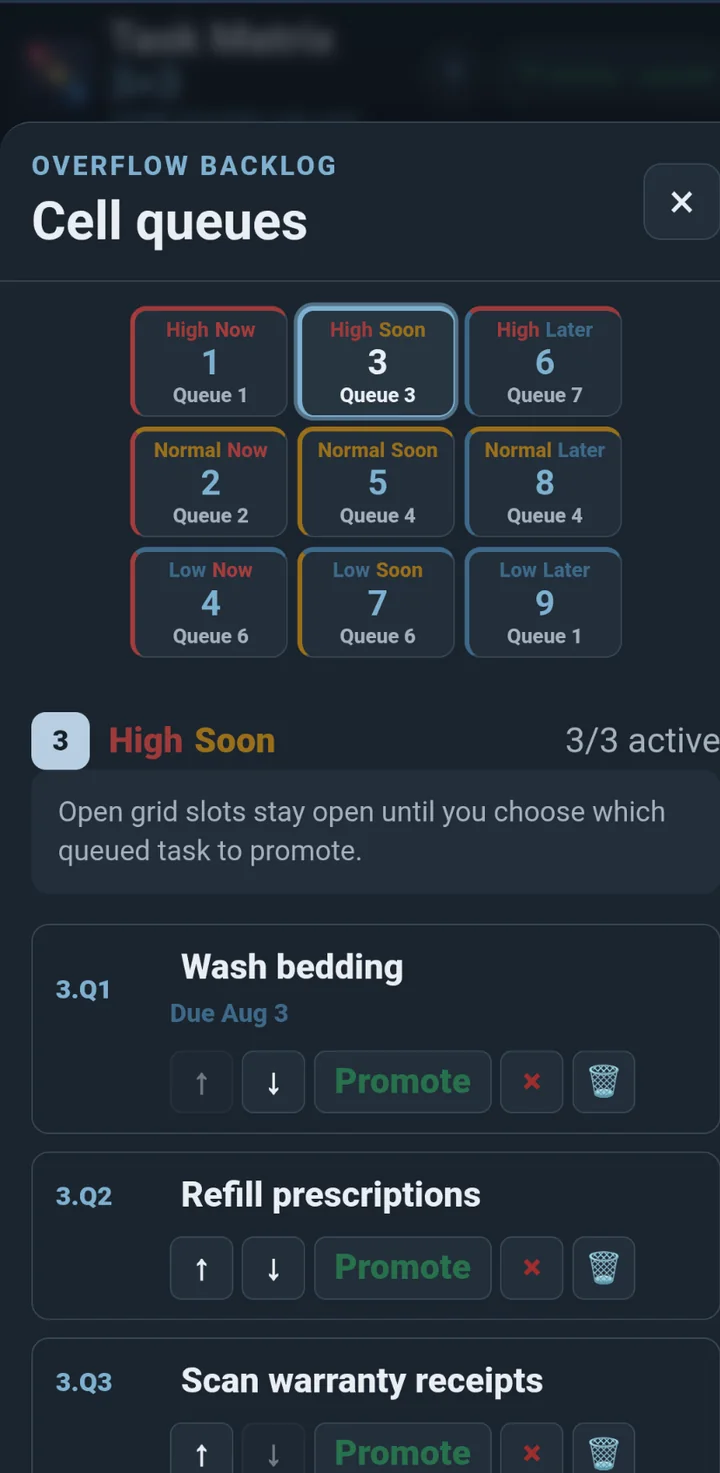
- Select Queue or Q on a cell. The number beside it is the number of waiting tasks.
- Use the cell tabs to inspect other queues without closing the window.
- Use the up and down arrows to change queue order.
- Select Promote to move a queued task into an active slot.
- Use Edit, Cancel, or Delete as needed.
Promoting into a full cell
If the cell is already full, Task Matrix 3x3 asks whether to promote the selected task into slot 3. Confirming moves the previous slot 3 task to the front of the queue.
Queued task numbers use a Q, such as 5.Q1, 5.Q2, and so on.
Calendar guidance without becoming a calendar
Due dates, times, and recurrence
A task may have a Due date, an optional Due time, both, or neither. Task Matrix 3x3 remains a task manager: it does not use Start dates, schedule work blocks, or manage project dependencies.
Due values
- A Due time requires a Due date.
- A Due date/time alone produces no email or log output.
- Timed Due values are stored in UTC and displayed in each device's local time zone.
- Date-only tasks remain calendar dates and use the end of that day for overdue display.
Due-date colors
| Color | Meaning |
|---|---|
| Red | The task is overdue. |
| Orange | The task is due today. |
| Green | The task is due within the next few days. |
| Blue | The task is due later. |
Repeat after completion
A recurring schedule may use day, week, month, weekday, quarterly, annual, positioned-weekday, limit, and exception rules. The preview shows the interpreted upcoming dates before you save.
Complete records completed history and creates the next occurrence. Skip immediately dismisses the current occurrence and its reminders, records skipped history, and creates the next occurrence. Cancel records cancelled history and ends the series. The next occurrence follows the prior schedule rather than the action date, skips missed dates, and fills an open slot or enters the same cell's queue.
A traditional view when you need one
Ordered List
The Ordered List is another view of the same Task Matrix 3x3 data. It does not create a second list or duplicate your tasks.
Choose what the list shows
- Include queued tasks off: shows only active tasks.
- Include queued tasks on: shows active and queued tasks together. Queued numbers include Q.
- Items per page: choose 10, 25, 50, 100, or All. Use First and Last to jump to the ends, Prev and Next to move one page, or -10 and +10 to move up to ten pages at a time.
Sort order
| Sort | Order |
|---|---|
| Priority #.# ascending | Uses the active Favor Importance, Favor Urgency, or Custom grid pattern, then each task’s active or queue position. |
| Due date ascending, then priority | Earlier due dates first. Undated tasks follow dated tasks. |
| Due date descending, then priority | Later due dates first. Undated tasks follow dated tasks. |
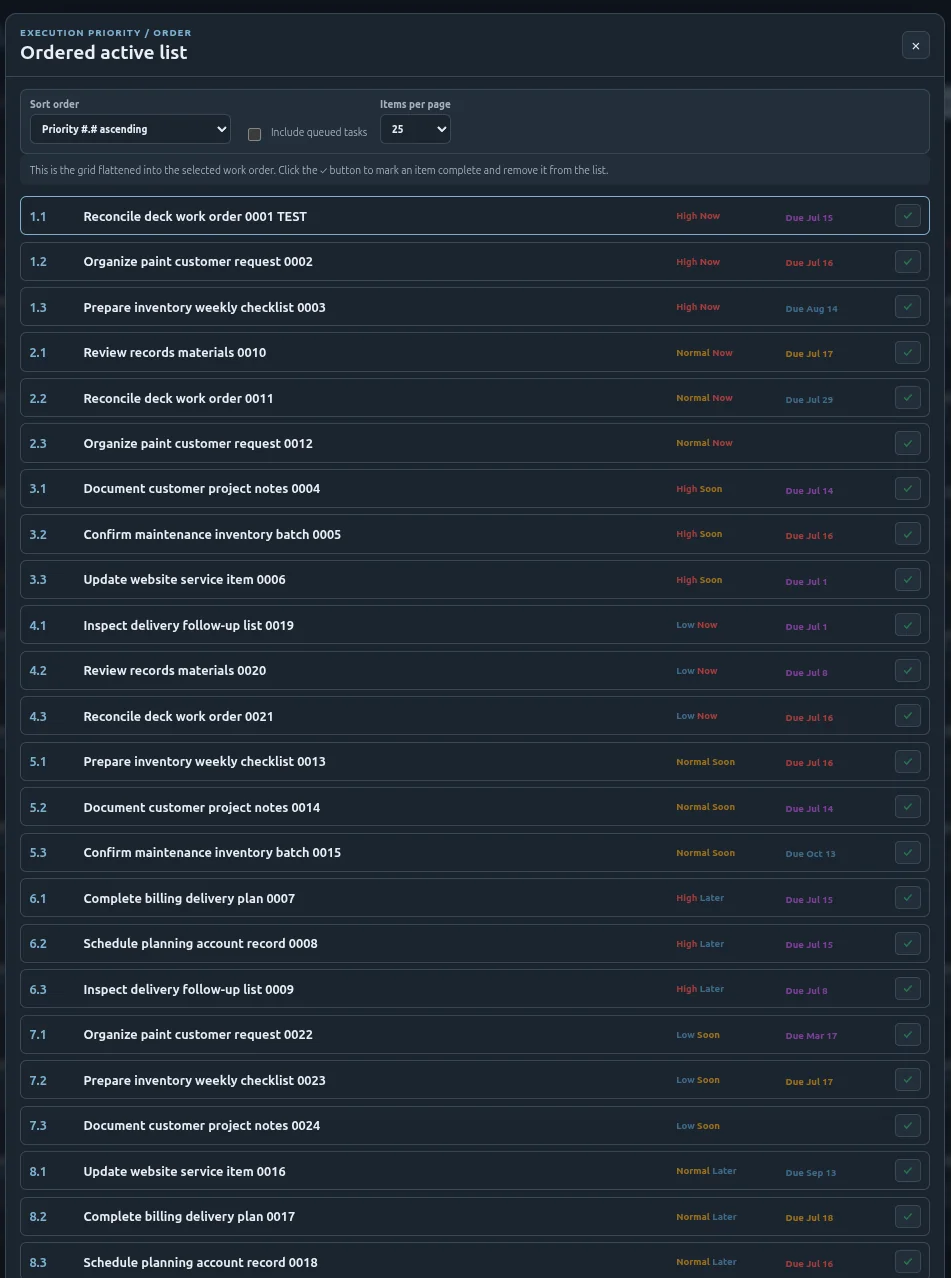
Select a task title to edit it. Select the checkmark to complete it. Any active viewing filter also limits the Ordered List. Changing a custom priority pattern immediately changes the priority numbers and the priority-sorted list, which is the purpose of the grid numbering.
Find and focus
Viewing filters
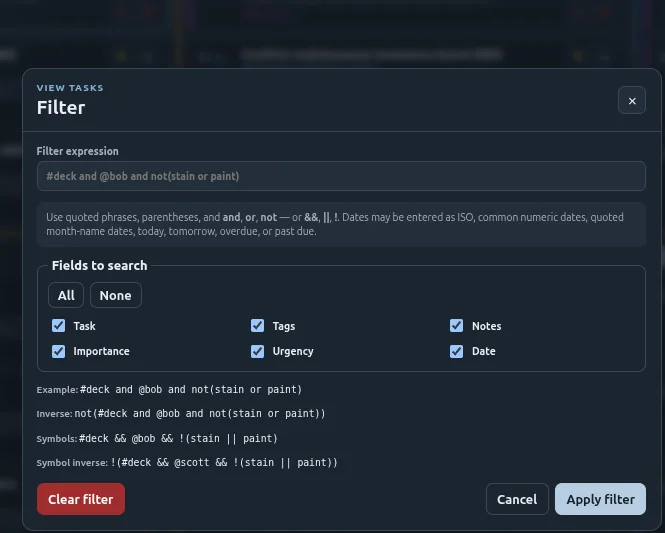
A filter changes what you see in the grid and Ordered List. It does not edit, move, queue, delete, or synchronize task data. The Filter button remains visibly active until you clear it.
Start with a simple search
Enter one word or phrase and select the fields to search. Examples:
deck
#house
today
overdue
high and now
Select Task, Tags, Notes, Importance, Urgency, and/or Date. The expression needs at least one selected field. Use All or None to change the field selection quickly.
Combine terms
| Word form | Symbol form | Meaning |
|---|---|---|
and | && | Both sides must match. |
or | || | Either side may match. |
not | ! | Exclude whatever follows. |
| Parentheses | ( ) | Control which parts are evaluated together. |
| Quoted phrase | "call supplier" | Keep several words together as one search term. |
not is applied first, then and, then or. Parentheses are the clearest way to express exactly what you mean.
Examples from simple to advanced
#deck and today
#deck and not paint
"call supplier" and (today or tomorrow)
high and now
#deck and @bob and not(stain or paint)
not(#deck and @bob and not(stain or paint))
#deck && @bob && !(stain || paint)
!(#deck && @bob && !(stain || paint))
Date searches
When Date is selected, Task Matrix 3x3 recognizes:
- ISO dates such as
2026-07-16. - U.S. numeric dates such as
7/16/2026. - Month-name dates such as
July 16 2026or16 July 2026. today,tomorrow, andyesterday.due,overdue, andpast due.- Partial displayed date text such as
July.
Save and recall a filter
- Build and test the expression and selected fields.
- Select Save as…, enter a useful name, and select Save. A saved filter keeps both the expression and field choices.
- Later, open Filter, choose the name from Saved filters, and select Apply.
- Select Cancel to close the Filter dialog without changing the active filter. Select Delete to remove the selected saved definition; it does not delete tasks.
Saving with an existing name asks before replacing it. Saved filters are included with task-data snapshots and JSON backups, so they can follow the shared task copy rather than being tied only to one browser.
When tasks seem to disappear
Look at the Filter button first. A filtered-out task is still present. Select Clear filter to restore the full grid and list.
If an expression is invalid, Task Matrix 3x3 displays an error and does not apply it. Check unmatched quotes or parentheses and make sure at least one field is selected.
Completed, skipped, and cancelled work
History
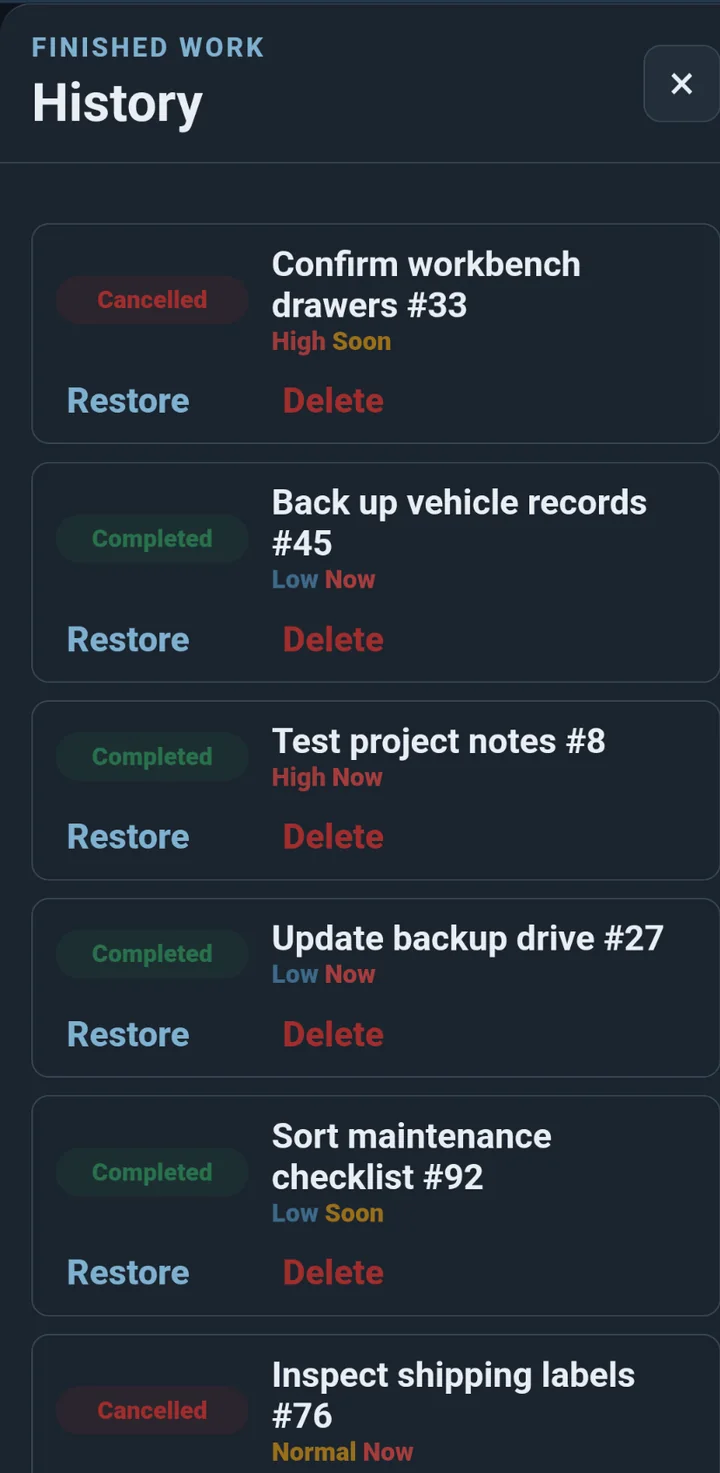
History keeps tasks that you marked Completed, Skipped, or Cancelled. It lets you review what happened, restore a task, or permanently remove it. Use Search to match the task title, tags, notes, cell, or status; narrow by Completed/Skipped/Cancelled and by event-date range; then choose how many events to show per page.
| Status | How it gets there | Can it be restored? |
|---|---|---|
| Completed | You selected the checkmark. | Yes. |
| Cancelled | You selected X and confirmed cancellation. | Yes. |
Find and page through History
The summary shows how many events match out of the total. Use First, -10, Prev, Next, +10, and Last to move through longer results. Clear removes the History search and filters without changing any event.
Restore a task
- Open Settings.
- Select History.
- Find the task and select Restore.
The task returns to its saved Importance/Urgency cell. It occupies an open active slot when available; otherwise it goes to that cell’s queue.
On a connected account, restoring or deleting History changes task data and therefore requires editing control.
One place to personalize and manage
Settings
Settings is the routine home for app preferences, account and device management, reminder delivery, History, backup tools, and sharing. You no longer need to open a separate account manager for normal account work.
| Area | What it controls | Scope |
|---|---|---|
| Favor / Custom priority | Standard Importance or Urgency order, or your own priorities 2–8. | This device or My account. |
| Grid orientation | Whether Importance or Urgency runs down the rows. | This device or My account. |
| Tag definitions | One-character tag meanings shown by the task editor's ? link. | Included in task snapshots and backups. |
| Text size | App text on large and compact screens. | This browser. |
| Account services and devices | Login, profile, password, pairing, device access, control, snapshots, and deletion. | Account-wide where applicable. |
| Time zone | How wall-clock schedules are interpreted and reminder dates/times are formatted. | Account-wide. |
| Reminder delivery | Email or Log, date order, delivery offset, Daily Digest window, and included fields. | Account-wide. |
| History | Search, restore, or permanently delete completed, skipped, and cancelled tasks. | Task data. |
| Backup / Restore | Export, import, merge, replace, or delete task data. | Current browser, then shared by the Active writer. |
| Share 3x3 | Public address and QR code. | No setting changes. |
Login-on-demand
Some actions require the account owner's login: approving a waiting device, editing Name or Phone, changing the password, managing registered devices, restoring snapshots, or requesting account deletion. When you request one while logged out, an in-app login dialog opens and returns you to Settings after successful login.
A paired device credential and an account-login session are different. A device can synchronize without leaving the account owner permanently logged in.
Switching grid preferences to My account
The first time you choose My account, choose whether to publish this device's current Favor, Custom pattern, and orientation or adopt the account's existing values. Text size remains local. Saved filters and tag definitions travel with task snapshots rather than grid-preference scope.
Optional online services
Accounts and devices
You do not need an account to use Task Matrix 3x3. Without one, tasks stay in that browser profile and the app continues to work offline.
What an account adds
- Shared snapshots and retained recovery versions.
- Email or private-log reminders while the app is closed.
- Optional use on more than one registered browser or device.
- Single-writer handoff so devices do not overwrite one another.
- Account-shared priority and grid preferences.
Create and confirm an account
- Open the Account page and choose Create an account.
- Enter Name, Email, Phone, and a password of at least ten characters.
- Use the confirmation link sent to the account email address.
- Return to the app and open Settings for routine management.
The Account page remains responsible for registration, email confirmation, login recovery, and forgotten-password reset. Routine profile and device work is in Settings.
Pair this browser or device
- Open Settings → Account services and devices.
- Enter a recognizable device name and select Get a code.
- Select Approve this device.
- When the login dialog appears, enter the account email and password.
- Wait for the app to confirm pairing, or select Check.
The code identifies the waiting browser; the login identifies its owner. If the code expires, cancel it and generate another.
Connect another device
Repeat the same steps on the additional browser. Only one Full-access device edits at a time. Export a JSON backup before pairing a browser that already contains important local tasks.
Know what this device may do
Device status
The status shown in Settings → Account services and devices tells you whether the current browser may edit and how it relates to the account.
| Status | What it means | What you can do |
|---|---|---|
| Active | This full-access device currently has editing control. | Edit normally, work offline if necessary, and select Sync now when online. |
| View only | This is a full-access device, but another device currently has control. | View and refresh shared data, or select Take control. |
| Waiting | This device requested control and is waiting for the active device to save and release it. | Wait, cancel the request, or use Force takeover when it becomes available. |
| Viewer only | The account owner restricted this device to viewing. | View and refresh data. It cannot request control, upload changes, or edit tasks. |
| Disabled | The account owner blocked this device’s access. | Log in through Settings on an allowed browser and change its access under Registered devices. |
| Access removed / Revoked | The device registration was removed from the account. | Generate a new pairing code and register it again if access is still wanted. |
Full access, Viewer only, and Disabled are account choices
Under Settings → Registered devices, each device has an access selection:
- Full access allows the device to become Active or temporarily View only.
- Viewer only allows shared-data viewing but never editing or takeover.
- Disabled blocks shared task data and account controls on that device.
View only is temporary control status. Viewer only is an access restriction. They are not the same.
One editor at a time
Taking control
Task Matrix 3x3 uses one active editor per account. This prevents two devices from independently changing the same shared task set and overwriting one another.
Normal handoff
- On a full-access View-only device, select Take control.
- The active device notices the request, pauses new edits, saves any pending changes, and releases control.
- The requesting device loads the most recently synced shared copy.
- The requesting device becomes Active and may edit.
When you selected an action such as Edit or Complete before requesting control, Task Matrix 3x3 remembers that action and resumes it after control is successfully obtained.
When the active device is unavailable
If the active device is closed, offline, lost, or otherwise unavailable, the request remains Waiting. After the displayed deadline, Force takeover becomes available.
When the former active device later reconnects, Task Matrix 3x3 protects any unsynced local work as an exportable recovery copy before it replaces that local view with the current shared data.
Sync now, Refresh data, and Release control
- Sync now asks the Active device to upload current changes immediately.
- Refresh data asks a View-only or Viewer-only device to check for and download the latest shared copy.
- Release control gives up editing control without assigning it to a particular device. Another full-access device can then take control.
Visible connected devices normally notice control or task changes within a few seconds while online. There is no need to keep manually refreshing under normal conditions.
Forget on this browser versus Remove from account
Forget locally deletes this browser's registration credentials only. The device remains under Registered devices. Remove there revokes its server access; it must be paired again to reconnect.
Individual output and a daily summary
Reminders
Scheduling and reminders are separate. A task can have a date or recurring schedule without sending email. Task Matrix 3x3 has no Start reminder model.
Individual reminders
- The task needs a date and time.
- At least one of its three Reminder fields must be something other than None.
- The Active device must sync the changed task to the account.
Available leads range from At the due time through 14 days before. Duplicate choices are collapsed and no more than three distinct reminders are stored.
Daily Digest
Daily Digest is an account-shared option. Choose when the digest is sent and a same-day start/end window. Date-only tasks due that day are included. Timed reminders inside the window are included in the digest instead of being sent again individually. Timed reminders outside the window remain individual.
Interval processing
The reminder worker runs on the administrator-selected 5, 10, 15, 20, 30, or 60 minute clock interval. Requested times are assigned to the boundary on or before that minute, so delivery is approximate and may be early. A reminder created after its boundary may be handled by the next run. Mail-provider delivery may add more delay.
Account configuration
Open Settings. Schedule and reminder choices are shared by the account and follow the latest accepted snapshot/settings state.
| Setting | Behavior |
|---|---|
| Time zone | Interprets wall-clock schedules and formats reminder output. Use an IANA name such as America/New_York or the device-zone shortcut. |
| Date format | Choose US MM/DD/YYYY or International DD/MM/YYYY. Numeric input follows that one order; ISO YYYY-MM-DD is always accepted. Two-digit years mean 20YY. |
| Deliver reminders by | Email sends through the configured email service. Log file writes the same output to the private mail-log directory for testing. |
| Delivery offset | Adds 0, 1, 5, 10, or 15 minutes to every individual task lead. |
| Daily Digest | Enable it, choose the send time, and choose the same-day start/end inclusion window. |
| Fields included | Task, Tags, Notes, Importance, Urgency, and Due date/time. Select only information appropriate for email or logs. |
| Processing interval | Read-only for users. The administrator selects 5, 10, 15, 20, 30, or 60 minutes. |
Email requirements
- The account email address is confirmed.
- At least one registered device is not Disabled or Revoked.
- Settings selects Email rather than Log file.
- The account reminder service and email delivery are working.
Log delivery does not send email. It writes the same output to the private mail-log directory and is useful for testing content and timing.
What arrives
Ready individual reminders and Daily Digest entries are grouped separately. Each logical entry has a unique delivery record to suppress duplicates and cap failed attempts.
Change or stop reminders
Edit the task, its schedule, or its Reminder fields, or Complete, Skip, Cancel, or delete it; then sync the Active device. Complete and Skip create the next recurring occurrence. Cancel ends the series. A timed task with all Reminder fields set to None produces no individual reminder; a date-only task may still appear in an enabled Daily Digest.
Without an account, reminders cannot be processed reliably while the app is closed because the task data remains only in that browser.
Routine management without leaving the app
Account management
Open Settings → Account services and devices. Log in through the in-app dialog when an operation requires the account owner's session.
Profile and password
- Change Name or Phone after entering the current password.
- Email remains the account identifier and is shown in the account summary; Registration information contains only editable Name and Phone fields.
- Change the password by entering the current password and a new password of at least ten characters.
- Use the Account page's Forgot password? flow when you cannot log in.
Registered devices
Settings lists device names, access modes, the Active writer, and current control. From there you can rename a device, choose Full access/Viewer only/Disabled, remove its credential, or release account control.
Retained snapshots
Settings lists retained shared snapshots and storage use. Restoring one protects the current shared copy, makes the chosen revision current, releases control, and requires every device to refresh. Delete removes one older copy; Delete all removes every older retained copy after confirmation while keeping the current shared copy.
Delete the account
Requesting deletion immediately blocks account and device access. During the grace period, log in through Settings and cancel the request. After the grace period, account data, devices, snapshots, preferences, sessions, and tokens are permanently removed.
Protect your work
Backup and recovery
Task Matrix 3x3 provides three different recovery layers. They solve different problems and should not be confused with one another.
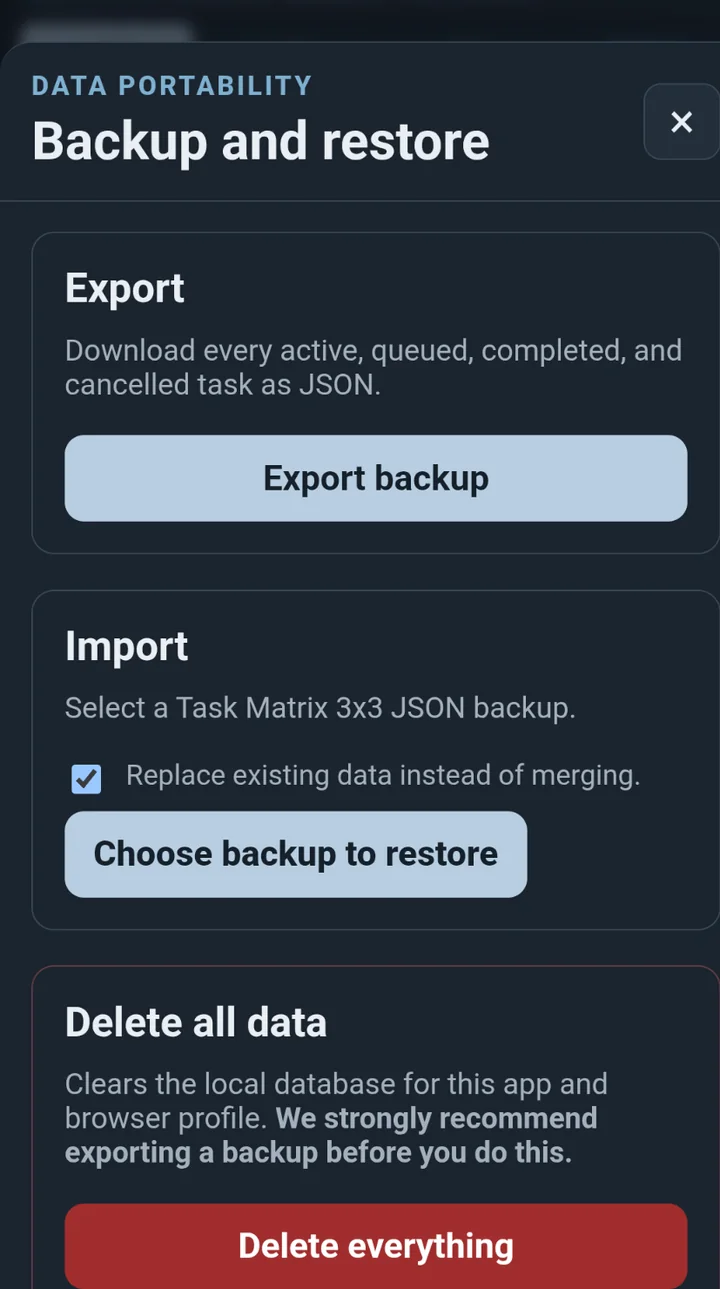
Download a JSON backup
- Open Settings → Backup / Restore.
- Select Export backup.
- Store the downloaded JSON file somewhere you can find it.
The file includes active, queued, completed, skipped, and cancelled tasks plus saved app settings. It does not include device registration credentials.
Import: Merge or Replace
| Choice | What it does | Use it when… |
|---|---|---|
| Merge | Keeps current tasks and adds imported tasks as additional items. Saved preferences contained in the backup may also be applied. | You want to combine two task sets and accept that matching tasks may appear twice. |
| Replace current data | Deletes current tasks and local saved settings, then loads the backup. | The backup should become the complete current task set. |
The Replace checkbox is off by default. Export the current data before either import when it matters.
Delete everything
This removes every active, queued, completed, skipped, and cancelled task from the current Task Matrix 3x3 database after two confirmations. It does not by itself remove the browser’s device registration.
Retained account snapshots
Settings lists older shared snapshots with their date, size, source device, and reason they were saved. Restoring one:
- Protects the current shared data in a safety snapshot.
- Makes the selected older version the new shared version.
- Releases editing control.
- Requires every connected device to refresh before continuing.
Deleting a retained snapshot removes only that recovery version. **Delete all** removes every older retained snapshot after confirmation. Both actions preserve the current shared data, but deleted recovery copies cannot be restored.
Recovery copy after force takeover
If another device forced control while the old Active device had unsynced changes, the old device preserves those changes locally when it reconnects. Open Settings → Account services and devices and select Export recovery copy.
The recovery copy is not merged automatically. Review it as a separate backup and decide what to re-enter or import.
Before clearing browser data
Export a JSON backup first. A browser’s general Clear site data or profile reset can remove locally saved tasks and device registration. Do not assume that every local change has already synced.
Use it like an app
Install and update
Installation is optional. Task Matrix 3x3 works in a normal browser tab, and an installed copy uses the same data for that browser profile.
Install on desktop or Android
Use the browser’s Install control when offered. Depending on the browser, it may appear in the address bar or application menu. If the Install control is unavailable, you can continue using the browser version.
Install on iPhone or iPad
- Open Task Matrix 3x3 in Safari.
- Select the Share button.
- Select Add to Home Screen.
- Confirm the name and select Add.
Updates
Task Matrix 3x3 checks for a new app release and normally updates itself. Close extra Task Matrix 3x3 tabs or windows, reopen while online, and check the footer to see the version and build currently running.
Your saved tasks are separate from the downloadable app files, so a normal application update should not remove them.
Safe update recovery
Use recover.html only when Task Matrix 3x3 remains stuck on an old version after closing and reopening it online. The recovery page removes old downloadable app files while preserving tasks saved in the browser.
What changes when you connect an account
Data and privacy basics
- Without an account: tasks and settings stay in the current browser profile unless you export them.
- With an account: connected devices send complete shared task snapshots to the account service so they can sync, recover, and generate reminders.
- Email reminders: only the task fields you select are placed in reminder messages.
- JSON backups: include tasks and saved app settings, but not device registration credentials.
- Device access: the account owner can restrict a registered device to Viewer only, disable it, or remove it.
This page explains product behavior, not the full legal policy. Use the application’s published privacy information for formal terms.
For experienced users
Quick reference
Priority order
| Priority | Favor Importance | Favor Urgency |
|---|---|---|
| 1 | High Now | Now High |
| 2 | Normal Now | Soon High |
| 3 | High Soon | Now Normal |
| 4 | Low Now | Later High |
| 5 | Normal Soon | Soon Normal |
| 6 | High Later | Now Low |
| 7 | Low Soon | Later Normal |
| 8 | Normal Later | Soon Low |
| 9 | Low Later | Later Low |
Task controls
✎ Edit ▲/▼ Reorder ✓ Complete ↷ Skip × Cancel 🗑 Delete permanently ⠿ Drag
Filter operators
and / && or / || not / ! parentheses single or double quoted phrases.
Date/time searches examine Due values. Terms include ISO, U.S. numeric, month-name dates, today, tomorrow, yesterday, due, overdue, and past due. Saved filters retain the expression and selected fields.
Reminder checklist
Individual: timed schedule + at least one task reminder + Active device synced. Daily Digest: enabled digest + a task due today in its window (or date-only). For Email delivery, also require a confirmed account, enabled registered device, a working account reminder service, and working email delivery.
Backup choices
Export creates your file. Merge keeps current tasks and adds imported ones. Replace makes the backup the current local set. Retained snapshot restore changes the shared account version for all devices.
Device controls
Sync now: upload Active changes. Refresh data: download latest shared data. Take control: request normal handoff. Force takeover: use the last synced shared copy when the old Active device is unavailable.
Troubleshooting by symptom
Common problems
Tasks, queues, and filters
Tasks seem to be missing
Check whether the Filter button is active. Select Clear filter. Also check the cell queue and History. A fourth task in a cell goes to its queue, and completed, skipped, or cancelled work goes to History.
I added a fourth task but do not see it in the cell
Select the cell’s Queue or Q control. A cell displays only three active tasks; additional tasks wait in its queue.
An active slot is empty even though the queue has tasks
Queue promotion is manual. Open the queue and select Promote on the task you want to bring forward.
I completed, skipped, or cancelled a task by mistake
Open Settings → History and select Restore. The task returns to its original matrix cell or that cell’s queue.
A filter expression will not apply
Make sure at least one field is selected. Check for unmatched quotes or parentheses. Try a simpler expression first, then add operators one at a time.
My saved filter is not listed
Confirm that you selected Save as… and completed the name dialog. On a connected account, saved filters follow the latest accepted task-data snapshot, so refresh or sync after a handoff.
A tag character has the wrong meaning
Open Settings → Tag definitions and edit it. Definitions are guidance only; changing one does not rewrite existing tag text.
Accounts and devices
I cannot edit
Open Settings → Account services and devices and check the status. A full-access View-only device can select Take control. A Viewer-only or Disabled device must have its access changed under Registered devices after the account owner logs in.
The device says View only
Another full-access device currently has control. You may continue viewing, select Refresh data, or select Take control.
The device says Viewer only
The account owner restricted this device to viewing. Log in through Settings and change Device access to Full access if it should be allowed to take control.
The device is Disabled
Use another permitted browser, log in through Settings, and change the device’s access under Registered devices. A Disabled device cannot reach shared tasks or account controls.
The pairing code expired
Return to Settings → Account services and devices, cancel the old request if necessary, and generate a new temporary code.
The account email was never confirmed
Open Settings, log in, and select Resend confirmation. Check spam or junk folders. Device registration and reminders remain disabled until confirmation.
Another device changed tasks but I do not see them yet
Keep this page visible and online for several seconds. Select Refresh data if needed. Confirm that the other device synced and that you are viewing the same account.
A takeover request is stuck on Waiting
The Active device may be offline or closed. Wait for the displayed deadline. Use Force takeover only when you accept that unsynced work on the unavailable device may not be in the shared copy.
A recovery copy is available
Select Export recovery copy before dismissing or changing anything. It contains local unsynced work preserved during handoff and is not automatically merged.
I cleared browser data and the device is no longer registered
Generate a new pairing code and register the browser again. Restore tasks from a JSON backup if they were not safely available in the account copy.
Email reminders
A reminder email did not arrive
Verify that the task has a Due date, Due time, and at least one reminder; the Active device synced afterward; Settings selects Email rather than Log; the account email is confirmed; at least one device is enabled; and the account reminder service and email delivery are working. Check spam or junk folders and allow for interval processing and mail-provider delay.
The reminder arrived at the wrong local time
Check the account reminder time zone rather than only the device clock. Use Use this device’s time zone when appropriate, save, and allow the Active device to sync.
The reminder omitted the task title or details
Open Settings → Reminder delivery and review Fields included in reminder output. Task, Tags, Notes, Importance, Urgency, and Due date/time are independent choices.
I changed or completed a task but reminders continue
Make sure the device with editing control synced the change. The worker uses the latest shared copy, not an unsynced local edit.
Backup, install, and updates
A backup import was rejected
Choose a JSON file exported by Task Matrix 3x3. Do not edit the file unless you understand its structure. Try downloading a fresh backup to confirm the import tool is working.
Merge created duplicate tasks
Merge intentionally adds imported tasks without trying to identify duplicates. Delete unwanted copies, or restore the pre-import backup with Replace if you exported one first.
The app shows an old version
Close all Task Matrix 3x3 tabs and installed windows, reopen while online, and check the footer. Use recover.html only if the normal update remains stuck.
The browser does not offer Install
You may continue using Task Matrix 3x3 in the browser. On iPhone or iPad, use Safari’s Share menu and Add to Home Screen. On other browsers, check the address bar or browser menu.
The app is offline
An Active or unregistered device can continue working with locally available data. Account syncing, pairing, control changes, and new reminder settings require an internet connection and resume when connectivity returns.
I am about to clear browser data
Stop and export a JSON backup first. General Clear site data can remove saved tasks and device registration. Use the narrower recover.html page for a stuck app update.
No matching help topics
Try a shorter word such as task, queue, reminder, device, or backup.